
Top 10 Substack Writers are Past 80
April 9, 2026
You are Gifted, not ADHD. Well, Maybe.
May 22, 2026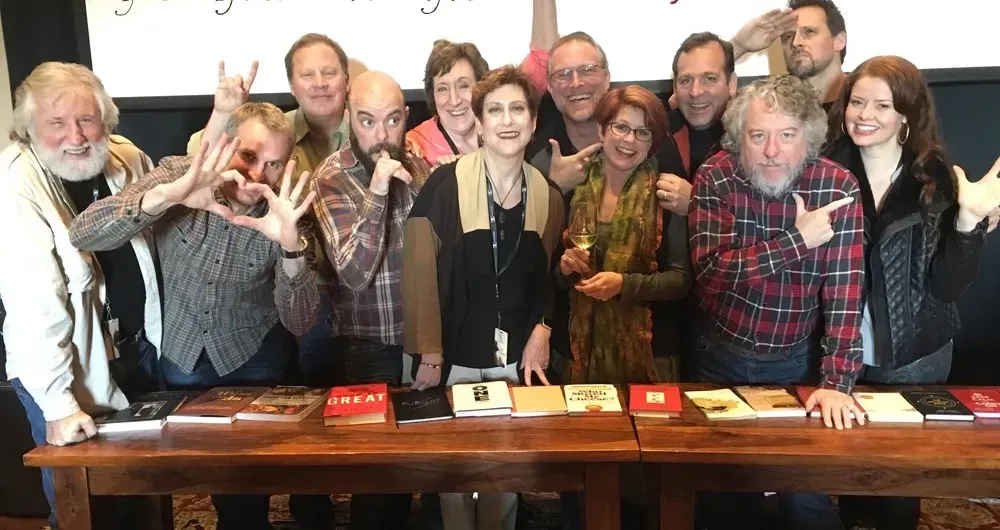
I love humans, especially the intelligent
The more I see about AI topics, the more I appreciate humans.
Even if you know how to use the AI tools and ask the bots to tell you how much noise, news, and analysis there’s been around chatbots or large language models since this all invaded our inboxes and minds since 2022, the answer is “it depends.” Let’s agree on this: The overwhelm you feel is real and you can nail Jello to the wall faster than you can find facts about AI you are willing to bet your business on.
What is real and growing as fast as the AI hype are communities where humans turn off their screens and spend all of that time saved by AI to transform themselves and their relationships with humans, nature, and their own health, physical and mental.

Credit Andrea B on Unsplash
Best Stories Around Intelligence Come From Our Community
There are three reasons why the stories you find in our community feel so right and reasonable to you. Most of our members are professional communicators, writers, and connectors. They connect words with your brain in a way no AI ever will. They connect with each other through stories and shared experiences. Most of them are also gifted, neurodivergent, or just plain exceptionally talented.
Because most of our members have always been pioneers and tend to show up in the leadership positions in the industries or life they have chosen, they are early adapters. Oh, for sure they know about AI but they don’t treat it as a savior or anything more than what it is. It’s math, not human intelligence.
We Can Go On and On, But We Won’t
Have you noticed that AI articles go on and on with lists, bullets, and a whole lot of work for you to make sense of it? It leaves me feeling used and abused. How about you?
Instead of trying to bring forward all of the articles we’ve loved lately, this is a sampler from the GPC Community voices, emails, and exchanges in the Notes area of Substack.
Why are we intensely interested—maybe obsessed, in learning more about intelligence, intellect, brain science, and humans? Where does this intersect with storytelling? How does it show up in our choices about professional commitments and more growth in our retirement years?
These are questions for humans. There’s no chatbot prompt or reason to trust artificial intelligence with these questions because 100% of the answers are in lived experience. AI is math, not human intelligence or intellect.
This essay started out as a way to make sense of high intelligence. That rapidly got off track in a curious, exploratory way by looking at what writers in our community have to say about intelligence–real and artificial.
The good news is our community is loaded with writers who have stories about decades of work and life experiences covering intelligence in more than 30 different contexts. The even better news is I’m not going to cover all of that now.
The benefit of all of those stories, articles and books is the reminder why we stick with humans. My writing is 100% human, for humans, about humans.

Credit Tim Mossholder
The Real Risk Isn’t AI. It’s Forgetting What People Are Worth
Kate Van Name weaves stories of sitting through 30 years of meetings. Board meetings. City council meetings. Zoom meetings. Her stories give you room to think, breathe, reflect, and notice your love for humans.
Start here with her reflection on work, value, and what actually matters when the task changes faster than we expected. As professionals, we have all reached this moment:
There is a brief moment, and it is a very human one, where it can feel as if the work has turned on you. As if, after all that time together, it has decided it no longer needs you in quite the same way. It would almost be easier if it were dramatic, if there were a clear before and after you could hold in your hands. Instead, it is subtle. Just enough to make you sit back in your chair and wonder if something essential just slipped out of your reach.
The mistake is not in the arrival of a new tool. The mistake is in believing that a person can be reduced to the last thing they were asked to do. When we let ourselves believe that, we stop seeing the pattern-sense, the patience, the judgment that was carrying that task all along.
Go here, next, with Kate and The disruption is not AI. It is how we respond to it.She offers a reflection on how we meet change, and why the difference has never been the tool.
The people who are going to move well with these tools are not the ones who memorize every option on the menu. They are the ones who stay clear on three things: what problem they are actually trying to solve, what trade they are actually willing to make, and who else is affected by the choice they are about to push through the system. They learn enough of the tool to stop being afraid of it. Then they turn most of their attention back to the part that has always been human: how we see the work, how we see each other, and how we choose to move when everything around us is speeding up.
Five Capacities You Built and AI Cannot Replicate
Lisa-Marie Cabrelli, Ph.D. wrote You’ve Been Building the Wrong Résumé Your Whole Life (and that’s the best news you’ll hear today)
Her story includes five capacities that took you decades to build, and that, for all its intelligence, AI genuinely cannot replicate.
Holding Ambiguity. Sitting with unresolved tension without needing to fix it.
Emotional Range. Reading rooms, calibrating tone, knowing what someone actually needs.
Surviving Failure Without Identity Collapse. And starting again.
Presence. Being with another person in their mess without making it about you.
Embodied Knowledge. Wisdom that lives in the hands, the body, the gut.
The Long View. Pattern recognition across decades of lived data.
Read the whole article to get full meaning for yourself. These five capacities may help you see yourself and others in ways that cut through thousands of articles and books on AI and brain science to make it real and immediately powerful.
Intelligence Is Not As Important as What You Do Next
Justin Welsh has covered intelligence from many angles and a dive into his archive of stories will help you find your way through every day and thousands of choices. In Intelligence can’t save you from disaster, Justin writes, A high IQ might technically make you a genius, but poor decisions can bring you down instantly.
Since wisdom prevents problems, its victories usually go unnoticed. We don’t celebrate all of the little disasters we avoid. We don’t give out awards for not joining pyramid schemes. There’s no trophy for catching a phishing email. Yet these little victories can actually be your greatest achievements.
AI is only math and a machine. Intelligent humans are full of laughter, brilliant ideas that even surprise them when it comes out of their mouth, and stupid mistakes that they make over and over, while feeling the joy of learning.
That’s the brain at work, giving us rewards. The brain loves patterns. It can handle confusion, mistakes, disappointments, love, and grief. The best part is neuroplasticity. That’s the secret of life and the forever unreachable place for AI.

Credit James Thomas
Did AI Remove the Moment You Once Owned as Human?
Mariah Faith Continelli writes The New Unhinged Substack and if you need anything sugar coated, you’ll need to buckle up to appreciate her research and depth. You can take it. Your brain is exceptional.
One click. Auto-fill. Auto-play. Auto fucking everything. And it worked, so beautifully. Things are faster. Smoother. Easier. You can accomplish more in five minutes than someone in 1998 could in a day. Stunning achievement. Minor side effect: we accidentally deleted the part where you actually think.
This is a decline in the conditions required to use intelligence.
Friction, as it turns out, was never just an obstacle. It was doing unglamorous, and cognitive labor. It forced you to hesitate for half a second, to compare, to reconsider, to experience that faint, irritating whisper of “is this actually a good idea?” That whisper is called judgment.
Convenience not only removed effort. It also removed the moment you would have questioned what you’re doing.
Here’s Something AI Will Never Enjoy: Wandering Intelligence
Lily Jedynak, Ph.D. writes about Wandering Intelligence. It’s the way that you move through life.
You’re probably familiar with the kind of intelligence that doesn’t move in straight lines. It doesn’t climb ladders or settle into a single identity. It doesn’t unfold according to syllabi, career pathways, or five-year plans. It roams, gathers, cross-pollinates. It learns by contact, immersion, pattern, resonance.
From the outside, this can look like instability. Unfocused, aimless, even immature. But “wandering intelligence” is oriented by curiosity, meaning and inner coherence. From the inside, it often feels like fidelity to something alive.
Wandering intelligence is how a system designed for complexity stays in motion.
Wandering intelligence isn’t a formal term with a single inventor, but it has deep roots across philosophy, psychology, neuroscience, and anthropology. It emerges at the intersection of several traditions that all noticed the same phenomenon: some minds are oriented towards exploration, pattern-bridging, and nonlinear meaning-making rather than linear goal pursuit.
Wandering intelligence is a mode of consciousness oriented towards exploration, pattern-bridging, and meaning-making rather than linear task completion. It’s a mind that moves because it’s listening for something larger than a single answer.
Enjoy the whole article to notice more than 10 specific patterns of wandering intelligence that may be exactly what you are experiencing.
A wandering intelligence needs a home base
Attachment theory, trauma research, and developmental psychology all point to the same truth: exploration only becomes joyful when there’s a secure place to return to. Without that, movement becomes anxious, and curiosity becomes compulsive.
That’s another reason why we created this community. It’s a home base. It’s more than a publishing platform or newsletter. It lives in the internet and that means it’s home 24/7, just as the physical place with a roof and plumbing that you call home.
Credit Aristol Branson
Nothing as powerful or as unknown as the human brain.
We can say the same for artificial intelligence because it is powerful and unknown, but here’s where it drops off the cliff and will never turn your thoughts into income.
Artificial intelligence is just math. It can take what is familiar to a human and turn it into math, then spit it back as words and images, which are nothing more than math. You learned this in every math class–math is linear and logical.
Your brain is not linear and sometimes not even logical. The way humans create and turn thoughts into money is with a complexity of connections nobody fully understands and an emphasis on messy and experimental, which is a place AI will never go.
Humans think about starts and finishes and the stories of our lives. Our work is about spending time in the messy middle and finding joy in learning and learning more. Humans are curious, mysterious, serendipitous, funny, sad, and full of awe and wonder.
Overthinking as well as impulse buying are daily possibilities for humans and AI can’t do that, either.
Why The GPC Community Formed and Why You Belong
Any stranger can make a recommendation, post a “like” or follow on social media and millions of them do. There is not much risk or personal investment in referrals or suggestions. What does it mean to you when someone says “you ought to meet this person” or “you ought to read this book”? They might as well say “you ought to go to the edge of that cliff and jump off.” Are they going to lock arms with you and make a personal commitment to make sure they are with you on the path they just pointed out? Are they going to do the thing they just suggested for you?
Somewhere after 40, most of us see through the systems and schemes designed to keep us working for the greater benefit of someone else. Someone else played you for as long as you would accept praise and acceptance while they turned your value into cash and paid you a small percentage of the 100% of you created. Somewhere after 40 you may be done with stupid, along with humans and tools that suck time and money with little to no personal investment in your goals.That’s where I landed after 55 and that’s why I started building a community for Gifted Professionals and Communicators.
What time I have left, let it be in the presence of intelligent humans. Connecting dots and seeing big pictures and small detail at the same time is one mark of genius. Connecting individuals who have a lot in common, including visions and resources is my joy.