
Intelligence That Cannot Be Automated
April 23, 2026
Networks We Nurture, Mailing Lists We Delete
June 1, 2026
Identical Does Not Mean Same Thing. Ask Any Parent of Identical Twins.
Why do we even bother to take up this subject again? Why do we feel like we have to explain everything twice or three times? It’s mentally exhausting to the gifted adult and more than irritating to adults with brains that run at the posted speed limit.
The human need for connection, love, and understanding is so strong that we can’t help but try again to find a way to create meaning, community, and common ground. I’ll bet you a case of champagne that the first person who said “A picture is worth a thousand words” was a gifted professional and communicator. I can’t prove it and you can’t either, but here’s what the brilliant brains in our community have taught me: Visuals get through to them faster than words.
Venn Diagrams Galore Instead of Words?
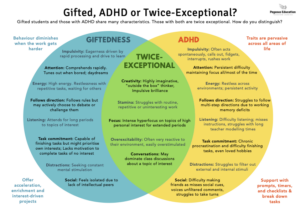
Why is it when I interview a brilliant adult who may or may not know they are gifted, they often reply by creating, then sending me a Venn Diagram and several stunning visuals of frameworks and systems diagrams? Few words, mostly visuals! Lucky for them, I get it. Not everyone does. That’s why the article this week by Kate Barton, an education consultant in Australia, struck me as something this community would not only love but would catch on immediately.
Identity is a big deal, and no matter where you stand in the debates increasing around labels such as giftedness, ADHD (attention-deficit/hyperactivity disorder), and Twice-Exceptional (2e), now you have the visual to help you sort it out. Kate Barton is a member of our community and helps us build the paths from childhood studies and practices to “what could this possibly mean or do us any good from age 18 to 98?”
Kate features this Venn Diagram in her article Gifted? ADHD? Both? A Practical Framework to Tell. She starts the conversation where she practices, “In the classroom, ADHD and giftedness can look nearly identical because both traits often manifest as restlessness, daydreaming and a rapid cognitive pace.”
Can she walk it out to say what this means to you, the professional and highly-skilled communicator past 40 who is still in the thick of living, changes, challenges, and everyday issues with human intelligence? Oh, and now artificial intelligence too, and world chaos?
Here’s How This Translates Into Adult Experience
Kate Barton added this to her Venn Diagram and article. Read it all and comment so we know that it’s responding to what you are doing and feeling NOW.
I am more familiar with the research that focuses on childhood issues than I am with research literature in gifted and twice exceptional adults, but translating what I do know in an adult context, I can see consistencies: Adults who are driven by wanting to make a difference in the world in whatever field, not really motivated by financial gains (more of a necessity), insist on excellence, like to tackle big, global questions or problems yet at the same time drill down to details to inform developing solutions, inquisitive, questioning, love learning and gain satisfaction from continuous learning, deep and philosophical thinking but at the same time possess strong pragmatism, think anything is possible/don’t see barriers or obstacles, devote huge energy to projects they believe in and can push unusual projects through (others might see their accomplishments as remarkable, but they see them as simply “what was needed”).
They are empathetic, altruistic and care deeply about the communities and environments around them, and can work across diverse industries. The downsides are that they are so cerebrally motivated they are vulnerable to not investing in their corporeal body, to burnout, sensitive to others perceptions of them, frequently underpaid, take on more than they should because they are driven to improve systems and outcomes and just see what has to be done, don’t find success (as traditionally indicated by salary, position etc) because they don’t necessarily want to “play the game” presented in traditional/corporate worlds, they don’t have the same driving values, are often undervalued, can be perceived as threatening to authority.
Their frustrations are similar to gifted/2e children fitting in to an industrialised schooling model in that they don’t conform to workplace frameworks, and can be perceived as “other” by peers.
I’m sure those whose brilliance is borne out through their works are the people who make great strides forward in the world for humanity, though there are many, many who will be quietly making waves in their local communities, unsung.
-30-
We’re on a mission to feature stories about professionals who are initiating meaningful conversations with other gifted minds and storytellers—and who they serve.
My clients are experts who don’t need more information. They need decisions and a system that matches their brain to turn ideas into stories and stories into NOW results. Not “someday” and not “after I feel ready.” Start with my Contact page to see how this works and the path forward for you.