
My Secret for Cutting Through the AI Noise
August 10, 2026
The Hero’s Journey, Part Two: When Was the Last Time Your Life Loved You Back?
August 18, 2026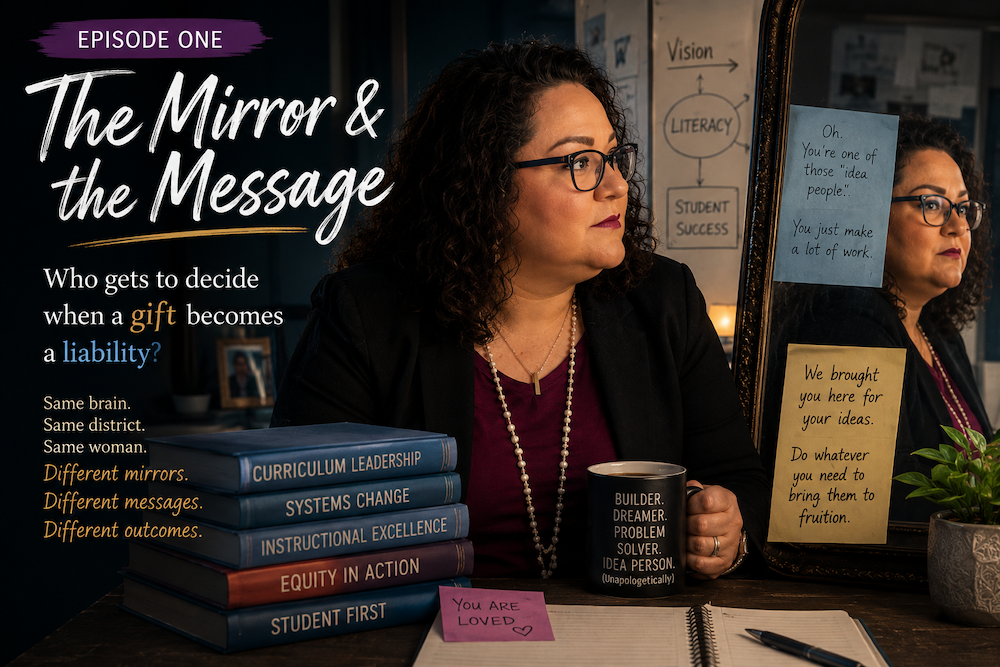
Who gets to decide when a gift becomes a liability?
We heard you. You want stories, not articles. Your brain is a story machine, seeking patterns and structure. This is a story from inside the world and mind of an origin founder of the GPC Community. Start here and come back twice for the whole adventure in three episodes:
One – The Trouble With Being an “Idea Person” (August 17)
Two- When was the last time your life loved you back? (August 18)
Three- The Road Back Isn’t Backward (August 19
By Brianna Schwenk, GPC Origins Author
For most of my life, I have generated ideas the way other people generate carbon dioxide.
Involuntarily.
Constantly.
Sometimes inconveniently.
Give me a problem and my brain immediately starts producing possibilities. Then possibilities for the possibilities. Then implementation plans for those possibilities. Then a vaguely related idea that could transform an entirely different system while we’re at it.
This is one of the ways my giftedness shows up.
I didn’t always have language for that.
A lot of gifted adults don’t.
Many people in my generation—and certainly many older than I am—weren’t identified in school. They grew up without anyone explaining why their brains seemed to run hotter, faster, deeper, or in more directions than everyone else’s.
So we developed other explanations.
I’m too much.
I overthink everything.
I get bored too easily.
I ask too many questions.
I care too much.
I can’t leave well enough alone.
Why can’t I just be satisfied?
And one of the crueler tricks of gifted adulthood is that the same characteristic can be rewarded in one room and punished in the next.
I learned that lesson rather spectacularly this year.
The Right Room
I came to Des Moines Public Schools because I believed deeply in the vision of the superintendent who hired me.
He was attempting to reimagine what instructional excellence could look like in a large, diverse, urban school system, and he surrounded himself with leaders who thought differently.
Many of us were unusual.
Creative.
Intense.
Restless.
Neurodivergent.
Builders.
I fit.
And fitting, when you have spent much of your life wondering whether you are simply too much, is intoxicating.
I remember Superintendent Ian Roberts telling me once that I had been brought to DMPS “for my ideas.”
Then he told me I should do whatever I needed to do to bring those ideas to fruition.
I don’t know whether he understood the magnitude of what those words meant to me.
Someone had looked directly at the thing I had spent years learning to moderate, translate, soften, organize, and occasionally apologize for and said:
That.
We hired you for that.
That is what it feels like to be seen.
And I flourished in that environment.
I built.
I dreamed.
I solved problems.
I generated more ideas.
Naturally.
I was surrounded by smart, unconventional people who were trying to do something audaciously difficult: make school better for kids at scale.
I loved the work.
Which matters to what happens next.
Because grief exists only in spaces where love once was.
When the Mirror Changes
In September, everything changed.
Superintendent Roberts was detained by federal immigration agents, setting off a national-news whirlwind that was surreal for everyone connected to the district. Soon afterward, the Chief Academic Officer who had also been instrumental in bringing me to Des Moines was gone.
Leadership changed.
The climate changed.
And, as often happens in organizations, the traits that had been adaptive under one set of conditions were interpreted very differently under another.
Months later, I was sitting with a group of Central Office directors as we tried to solve a problem.
Naturally, I had an idea.
I offered it.
The new Chief Academic Officer looked at me and said, in front of the group:
“Oh. You’re one of those idea people. You just make a lot of work for the rest of us.”
I laughed.
I think.
That’s one of the useful social skills you acquire when you’re intense enough to have spent a lifetime monitoring the temperature of rooms.
But the sentence stayed with me.
Because I had heard the opposite before.
We brought you here for your ideas.
And now:
You make too much work.
Same brain.
Same district.
Same woman.
Same characteristic.
To one leader:
Asset.
To another:
Liability.
There is an idea I keep returning to from Justin Welsh’s The Machine Is a Mirror. His argument centers on artificial intelligence, but the metaphor has lodged itself somewhere else in my brain.
What if institutions are mirrors, too?
What about careers?
Relationships?
Communities?
Put an intensely curious, prolific, systems-oriented person in one environment and she is visionary.
Put her in another and she is exhausting.
Put a deeply sensitive person in one relationship and she is compassionate.
Put her somewhere else and she is “too emotional.”
Give someone an unusual capacity for pattern recognition and she may be brilliant when the pattern is useful—and obsessive when everyone else would prefer to stop talking about it.
Maybe our liabilities and our assets aren’t separate characteristics at all.
Maybe they are the same characteristics reflected through different mirrors.
Which raises a question I have been thinking about ever since:
Who gets to decide whether your gift is a gift?
And perhaps an even more dangerous one:
What happens when you let the wrong mirror answer?
The Call to Adventure Was Apparently a Budget Meeting
Every English teacher knows that a proper hero’s journey requires disruption.
The hero begins in the ordinary world.
Then something happens.
A call to adventure arrives.
The comfortable order breaks.
Joseph Campbell probably envisioned dragons.
Mine involved Central Office.
Close enough.
On January 28, I walked into a meeting.
I walked out knowing that my position was being eliminated.
Budget.
Restructuring.
Efficiency.
All the antiseptic words organizations use to describe events that are anything but antiseptic to the human beings experiencing them.
And because my professional identity has never been something I could neatly detach from the rest of myself at 5:00 p.m., I didn’t experience it simply as:
I am losing my job.
I experienced it as:
The work I love doesn’t want me anymore.
That’s a very different wound.
For someone whose identity is deeply intertwined with her work, losing a job isn’t simply losing employment.
It is grief.
I didn’t know it yet, but my marriage was ending, too.
Soon, I would be looking for a new job, a new home, and a new understanding of who the hell I was if I was no longer several of the things I had used to define myself.
But heroes aren’t usually aware that they’ve entered the story while it is happening.
They just know the ordinary world is gone.
And mine was.

The Conversation
I’m curious about the mirrors in your own life.
Has a quality you once learned to think of as “too much”—too intense, too sensitive, too curious, too restless, too ambitious—ever become precisely the thing someone else valued most about you?
Or has the reverse happened? What is the story you can share?
You don’t have to answer publicly. That’s why we have a private conversation form inside the community for Gifted Professionals & Communicators. One question to help us see you and the story you’ve been living.
Next: Part Two — When was the last time your life loved you back?
Our interview series features interesting people with something to say that the world needs to hear. Let me know what you think—we’ll continue to experiment and evolve along the way.