
The Hero’s Journey, Part Two: When Was the Last Time Your Life Loved You Back?
August 18, 2026
I no longer require my ducks to be in a row.
September 8, 2026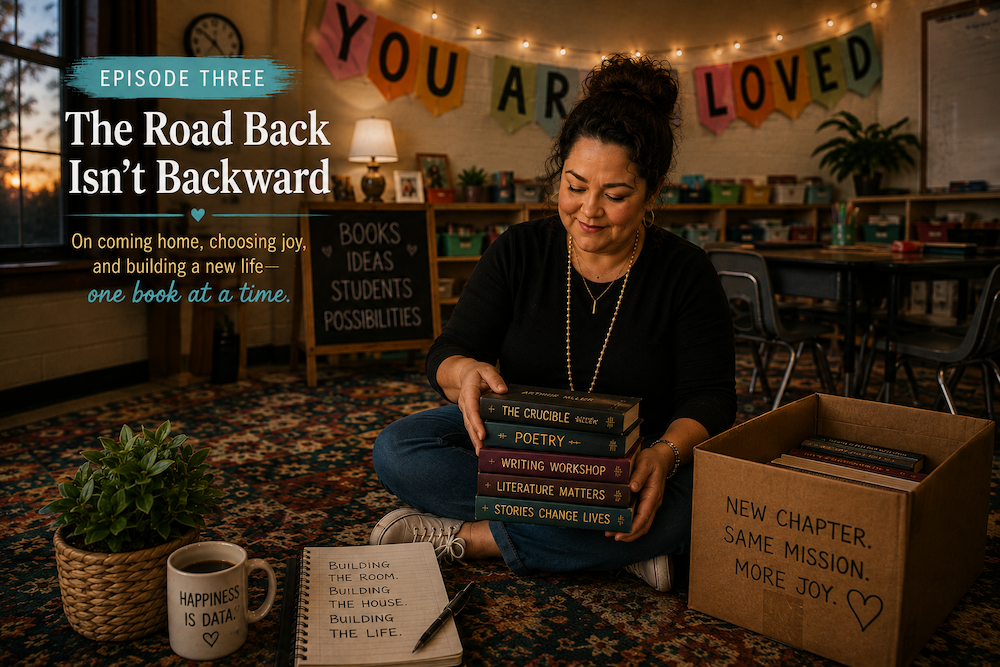
On career ladders, starting over, coming home, and learning to count happiness as data
We heard you. You want stories, not articles. Your brain is a story machine, seeking patterns and structure. This is a story from inside the world and mind of an origin founder of the GPC Community. Follow along for the whole adventure in three episodes:
One – The Trouble With Being an “Idea Person” (August 17)
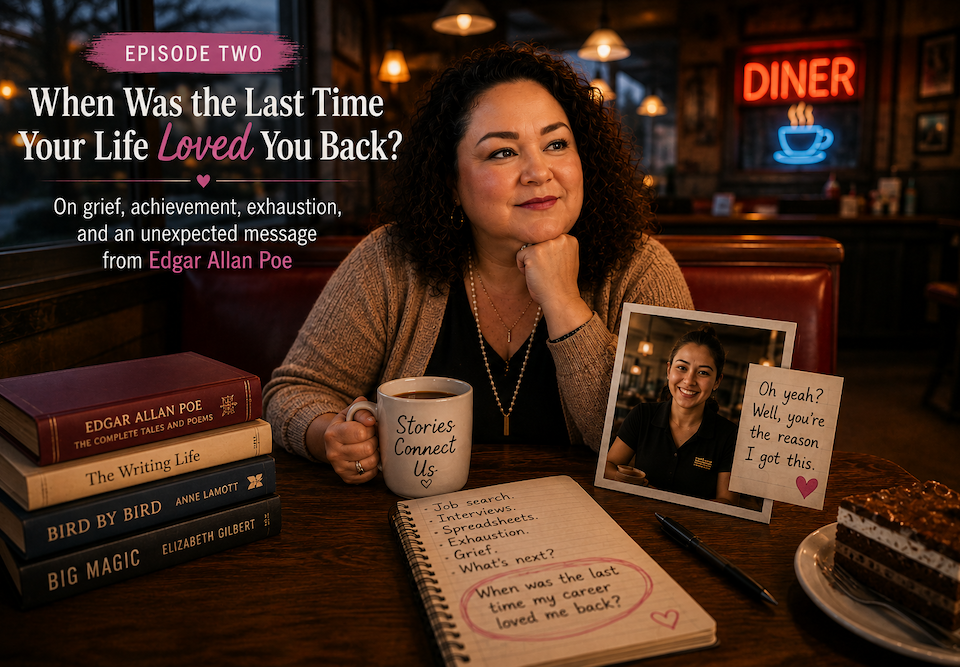
Two- When was the last time your life loved you back? (August 18)
Three- The Road Back Isn’t Backward (August 19)
By Brianna Schwenk, GPC Origins Author
I am writing this from a messy high school English classroom.
There are boxes everywhere.
There are books without homes, supplies without systems, furniture I have moved three times because apparently I cannot determine the optimal location of a bookshelf without first considering seventeen competing theories of adolescent literacy, traffic flow, aesthetics, classroom community, and feng shui.
This is what happens when you give an idea person a classroom.
We make a lot of work for everyone.
Mostly ourselves.
Today was New Teacher Orientation.
Which means that after nearly a decade as an administrator—the person who helped plan professional development, coached principals, designed systems, led curriculum work, wrote strategic plans, facilitated leadership teams, and occasionally stood at the front of rooms explaining what excellent instruction ought to look like—I sat in a chair with the other new teachers and listened.
And I was ridiculously happy.
Not relieved.
Not resigned.
Not “making the best of things.”
Happy.
This is worth noting because, by several conventional measures, I have recently blown up my life.
At 40, I divorced my husband.
I moved into my first home by myself.
My administrative position in one of Iowa’s largest school districts was eliminated.
And after spending years climbing the educational leadership ladder, I voluntarily climbed several rungs back down and returned to the classroom.
There are people who might call this “starting over.”
There are people who might call it “going backwards.”
There are probably people with impressive LinkedIn profiles who could turn it into a seven-slide carousel about resilience.
I think they are all wrong.
Achievement Is Very Good at Measuring Altitude
Here’s the uncomfortable thing about ambition:
It is very good at measuring altitude.
Up is good.
Down is bad.
Teacher.
Instructional coach.
Coordinator.
Director.
Principal.
Superintendent.
Whatever your industry’s ladder looks like, we are taught to climb it.
And gifted people can be particularly susceptible to this.
We are accustomed to achievement.
We like challenge.
We like mastery.
We like the dopamine hit of being handed something difficult and figuring it out.
For many of us, competence becomes part of identity.
And then competence starts making decisions for us.
You could do this.
Therefore:
You should do this.
And eventually:
If you stop doing this, perhaps you weren’t as capable as everyone thought.
That last one is particularly vicious.
Because what happens when the brave choice isn’t another rung up?
What happens when the right choice looks, from the outside, like going backward?
I wrestled with that.
And then I realized I was asking the wrong question.
The question wasn’t:
Am I moving backward?
It was:
Am I moving toward something I want?
Those are not the same thing.
Achievement isn’t altitude.
Growth isn’t linear.
And a pivot isn’t necessarily an admission that the journey failed.
Sometimes a pivot is what happens when you’ve learned enough from one road to recognize that you don’t want to see where it ends.
My First House
Around the same time I was choosing to return to the classroom, I was moving into a home by myself for the first time in my life.
At 40.
There is something both terrifying and exhilarating about realizing that every decision in a space belongs to you.
Where does this go?
Wherever I want.
What color should this be?
Whatever color I want.
What should I eat for dinner?
Apparently cheese over the sink.
Nobody is supervising.
But the larger realization was more profound.
For much of my adult life, I had constructed success out of recognizable pieces.
Marriage.
Home.
Career advancement.
Leadership.
Achievement.
Responsibility.
More.
And then, within a remarkably compressed period of time, I began taking that structure apart.
Some pieces were taken from me.
Some I put down willingly.
Some I realized I had been carrying long after they stopped belonging to me.
And underneath all of that dismantling was a question:
What if the life I’m capable of building isn’t the same life I actually want to live?
I don’t have a neat answer to that yet.
I’m living it.
The Hero Comes Home
English teachers love a good Hero’s Journey.
The hero leaves the ordinary world.
Crosses the threshold.
Meets mentors.
Faces trials.
Loses things.
Gets knocked around.
Descends into the abyss.
Discovers something she couldn’t have learned by staying home.
And then something interesting happens.
She returns.
The Hero’s Journey is not a straight line toward somewhere bigger.
It is a circle.
You come home.
But you don’t come home as the person who left.
I spent ten years away from the classroom.
I learned how systems work.
I learned curriculum.
Instruction.
Budgets.
Grants.
Politics.
Organizational leadership.
Change management.
Strategic planning.
I learned what leadership can unlock in someone.
I learned what leadership can diminish.
I learned that being seen is powerful.
I learned that being misread is painful.
I learned that no title protects you from uncertainty.
I learned that achievement and fulfillment are not synonyms.
And now I am back where I started.
But I am not the woman who left.
Maybe I didn’t climb back down the ladder after all.
Maybe I misunderstood the genre.
A Job That Loves You Back
Now I’m thinking about discussions of The Crucible again.
About the books I want kids to discover.
About writing.
About laughter.
About the moment when a student who insists they “hate English” accidentally gets passionate about something we’re discussing and forgets to be disengaged.
About noticing the quiet kid.
About pushing the brilliant kid.
About telling someone:
No, seriously. You are good at this.
About all the tiny interactions whose importance I may never know.
Maybe one of them will get a Poe tattoo.
God help their parents.
And yes, I still love leadership.
I still believe I have something to contribute as an administrator.
Perhaps returning to the classroom will someday make me a much better one.
Because I will remember again what it feels like when the bell rings and twenty-eight teenagers walk through the door.
I will remember the cognitive load.
The emotional labor.
The thousand decisions.
The absurdity.
The joy.
The exhaustion.
The fact that the most elegant strategic plan in the world eventually has to survive third period on a Tuesday.
But I am not treating this year as an intermission before I return to something “bigger.”
This is the thing.
This life counts.
This chapter counts.
This classroom counts.
The salary cut is real.
The uncertainty is real.
The grief was real.
So is the joy.
And maybe, after a lifetime of achievement metrics, strategic plans, goals, evaluations, dashboards, rubrics, and data-driven decision making, I am finally learning to measure something different.
I’m allowing happiness to count as data.
I’m allowing peace to count as achievement.
I’m allowing a pivot to mean possibility instead of failure.
Tomorrow, I’ll walk back into my unfinished classroom.
I’ll open another box.
I’ll put another book on a shelf.
I’ll probably move that goddamn bookshelf for the fourth time.
And slowly—book by book, decision by decision—I’ll build the room.
Just as I’m building the house.
Just as I’m building the life.
Maybe that’s what I’ve been doing all along.
Not starting over.
Building again.
The Conversation
I’ve told you what my pivot looks like.
I’d like to know about yours.
Maybe you made it years ago.
Maybe you’re standing at the fork right now.
Maybe there’s a road you keep looking toward but haven’t yet given yourself permission to take.
Maybe the thing you’re afraid looks like “going backward” is actually calling you home.
What would change if you stopped asking whether the next move looked impressive—and started asking whether it felt alive?
You don’t have to answer publicly. That’s why we have a private conversation form inside the community for Gifted Professionals & Communicators. One question to help us see you and the story you’ve been living.
Our interview series features interesting people with something to say that the world needs to hear. Let me know what you think—we’ll continue to experiment and evolve along the way.